
Bank reconciliation statement
Contents:
- Definition and explanation
- Reasons for difference
- Steps in preparing a bank reconciliation statement
- Example
Definition and explanation:
A bank reconciliation statement is a document that depositors prepare to identify and explain any differences between the cash balance on their bank statement and the balance in their accounting records. All transactions between the depositor and the bank are recorded by both parties. These records may disagree for various reasons and show different balances. The purpose of preparing a bank reconciliation statement is to determine the reasons for this discrepancy.
Reasons for Differences Between the Bank Statement and Accounting Records:
Usually, the balance on the monthly bank statement does not agree with the depositor’s accounting records. The common reasons for this disagreement are listed and briefly explained below:
1. Outstanding/unpresented checks:
Outstanding checks (also known as unpresented or uncleared checks) are checks that have been issued by the depositor in favor of a creditor but have not yet been presented for payment. The amounts of these checks are recorded by the depositor when issued, but no entry is made by the bank until the checks are actually presented and paid. Unpresented checks, therefore, cause a difference between the balance in the company’s accounting records and the balance on the bank statement for the period concerned.
Example:
You issued a check to Mr. X (one of your creditors) for $500 on January 31, 2021, and entered it immediately in your accounting records. However, Mr. X did not present or deposit that check into his account before the end of January. Consequently, your January bank statement will not show this $500 deduction. This creates a $500 difference between the balance in your accounting records and the balance on your bank statement.
2. Deposits in transit:
Deposits in transit refer to cash or checks received and recorded by the depositor that have not yet been credited by the bank on the bank statement. This usually occurs when deposits are made on or near the last day of the month.
Example:
You received $800 from Mr. Y (one of your debtors) on January 31, 2021, and recorded it immediately in your accounting records. You then sent this cash to your bank to be deposited into your account, but it arrived too late to be included on your bank statement for January. Consequently, the balance in your accounting records will differ from your bank statement balance by $800.
3. Credit entries for interest earned:
Banks pay interest on certain types of accounts. If this interest is credited to the depositor’s account without notifying the depositor, the bank statement and the depositor’s records will not agree.
4. Service charges deducted by the bank:
Banks provide various services to their customers and deduct service charges from their accounts. Depositors are usually unaware of these deductions until they receive their bank statement. Consequently, these charges create a difference between the balance on the bank statement and the balance in the depositor’s records.
5. NSF Check:
NSF stands for Non-Sufficient Funds (or Not Sufficient Funds). When a customer deposits a check into their account, the bank often credits the account with the check amount right away. Sometimes, such checks are not honored because the person who issued the check does not have sufficient funds in their account. In such a situation, the bank reverses the entry and reduces the depositor’s account balance back to its previous amount. The dishonored check is then returned to the depositor as an NSF check.
Example:
You received a check from Mr. A for $1,000. You entered it immediately in your accounting records and deposited the check into your account. Upon deposit, your bank immediately credited your account with $1,000. Afterward, your bank notified you that Mr. A’s bank did not honor the check because there were insufficient funds in his account. Your bank reduced your account balance by $1,000 and returned the dishonored check to you as an NSF check. Consequently, the balance in your accounting records will differ from your bank statement balance by $1,000.
Steps in preparing a bank reconciliation statement:
Step 1 – Find the deposits in transit:
The first step in preparing a bank rconciliation statement is to check whether one or more deposits are in transit. You can do this by comparing the deposits in your accounting records with the deposits shown on your bank statement. If you find a deposit in your accounting records that does not appear on the bank statement, it means that particular deposit is still in transit and has not yet been credited to your account by the bank.
Treatment:
Add all deposits shown in your accounting records that have not yet been entered on the bank statement to the bank statement balance.
Step 2 – Find outstanding/unpresented checks and deduct from bank statement balance:
Find all checks that you have issued that have not yet been presented for payment. You can do this by comparing the checks recorded in your accounting records with the checks cleared on your bank statement. If your accounting records show that a check has been issued, but your bank statement does not show a corresponding entry, this means it is an outstanding or unpresented check.
Treatment:
Deduct the amounts of any checks that you have issued and entered in your accounting records, but that have not yet been presented and paid by the bank, from the bank statement balance.
Step 3 – Find and add credit memorandum to your accounting record:
Banks issue a credit memorandum when they collect a note receivable (or other funds) on behalf of the depositor. Check whether your bank has issued any credit memoranda that you have not yet entered in your accounting records.
Treatment:
Add any credit memoranda that you have not already entered to your accounting records.
Step 4 – Find and deduct debit memorandum from your accounting record:
Banks provide various services to their depositors, such as printing checks, processing NSF checks, and collecting notes receivable. They usually deduct charges from the depositor’s account for these services and notify the depositor about the deductions by issuing a debit memorandum. Check whether there are any debit memoranda that have not yet been recorded in your accounting records.
Treatment:
Deduct any debit memoranda issued by the bank that have not yet been entered in your accounting records.
Step 5 – Are the adjusted balances equal?
Check whether the adjusted balance in your accounting records equals the adjusted balance on your bank statement.
Step 6 – Make appropriate journal entries:
The final step of the bank reconciliation process is to prepare appropriate journal entries for the items causing differences that you have not yet recorded in your accounting records.
To better understand how a bank reconciliation statement is prepared, consider the following example:
Example
The bank statement of Fast Company shows a balance of $10,000 on January 31, 2021, whereas the company’s ledger shows a balance of $8,525. The following reasons have been identified for this discrepancy:
- An amount of $822 sent to the bank for deposit on January 31, 2021, does not appear on the bank statement.
- The following checks issued during the month of January have not yet been cleared by the bank:
Check No: 201, Issue date: January 15, 2021, Amount: $200
Check No: 212, Issue date: January 19, 2021, Amount: $20
Check No: 216, Issue date: January 25, 2021, Amount: $610 - A note receivable amounting to $1,588 has been collected by the bank for the company.
- The bank statement shows that interest amounting to $50 has been earned on the average account balance during January.
- The bank has charged $10 for the collection of a note.
- A check for $100 deposited by the company has been charged back as an NSF check.
- An amount of $25 has been deducted by the bank as service charges for the month of January.
- Check No. 220 was issued to the electricity company. The check was in the amount of $95, but it was erroneously recorded in the cash payments journal as $59. The credit entry in the journal is, therefore, understated by $36 ($95 − $59).
Required: Prepare a bank reconciliation statement for Fast Company using the above information. Also, prepare journal entries to update the company’s accounting records.
Solution
(a). Bank reconciliation statement
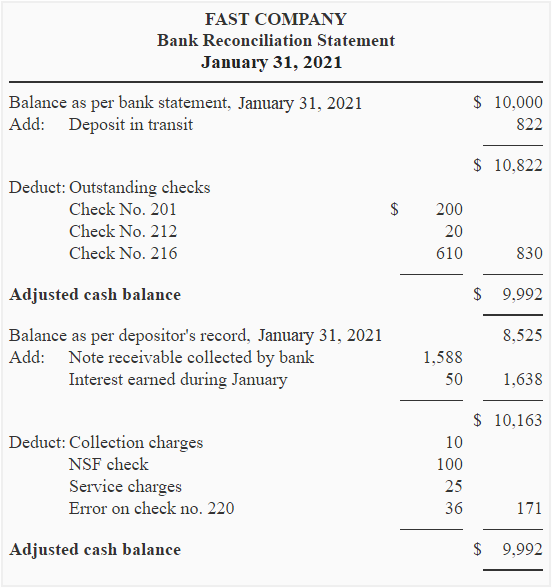
(b). Journal entries to update the company’s accounting records
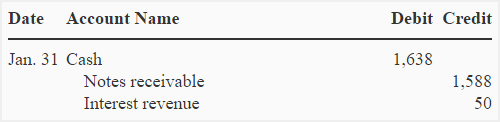
To record cash receipts:
To record cash payments:
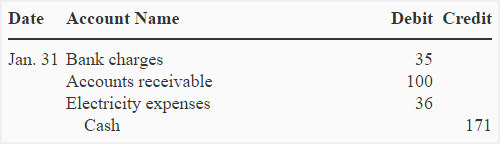
Note: We have recorded two journal entries to update the accounting records of Fast Company—one for cash receipts and one for cash payments. Alternatively, separate journal entries for each item, or a single compound entry, can be prepared to update the depositor’s accounting records.
It was helpful
great example
It is a big help for me …
it was helpful to me,
Thanks for this information
It is helpful.
I like your explanation