
Book value per share of common stock
What is book value per share?
Book value per share (BVPS) of common stock is the amount of net assets that each share of common stock represents. Since the number of shares owned by a stockholder determines his or her portion of equity in a corporation, some stockholders have a keen interest in knowing the book value of the stock they own. In this article, we will explain how this value is calculated in different capital structures.
Formula and calculation:
Book value is mostly calculated for common stock only. The presence of preferred stock in total stockholders’ equity, however, has a significant impact on the calculation. The formulas and examples for calculating book value per share—with and without preferred stock—are given below:
(1). If company has issued only common stock and no preferred stock:
The calculation of book value is very simple if a company has issued only common stock. The net assets (i.e., total assets less total liabilities) can be divided by the number of shares of common stock outstanding for the period.

We know that:
Net assets = Assets – Liabilities
Or
Equity = Assets – Liabilities
Or
Net assets = Equity
Considering the above relationship between assets, liabilities, and owners’ equity, an alternative and equally acceptable approach is to replace the numerator of the formula with stockholders’ equity. After this modification, we get the following widely used formula for calculating book value per share:

Example:
Calculate the book value per share from the following stockholders’ equity section of a company:
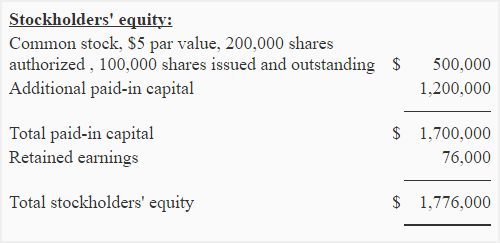
Solution:
= $1,776,000/100,000 shares
= $17.76 per share of common stock
(2). If company has issued common as well as preferred stock:
If a company has issued common as well as preferred stock, the amount of preferred stock and any related dividends in arrears are deducted from total stockholders’ equity, and the resulting figure is divided by the number of shares of common stock outstanding for the period. This procedure can be summed up in the following formula:

Example:
Calculate the book value per share from the following stockholders’ equity section of a company:

The preferred stock shown above in the stockholders’ equity section is cumulative and dividends amounting to $48,000 are in arrears.
Solution:
= [$2,576,000 – ($800,000 + $48,000)]/100,000 Shares
= $1,728,000/100,000 Shares
= $17.28 per share of common stock
Book value and market price relationship
Book value per share (BVPS) can help investors gauge whether a company’s stock price is reasonable, though it should be used cautiously in stock analysis and investment decisions. Buying a stock below its book value is not always a bargain.
Because book value is rooted in historical accounting data, it reflects stockholders’ original investments and retained earnings rather than current market realities. When a stock trades above its book value, investors generally believe management has built a business worth more than the historical cost of its assets and expect it to grow over time. Conversely, when a stock trades below its book value, the market is signaling skepticism that current management can generate adequate returns from those assets. Ultimately, comparing a stock’s market price to its book value serves as a useful barometer of investor confidence in a company’s leadership and future prospects.
Leave a comment